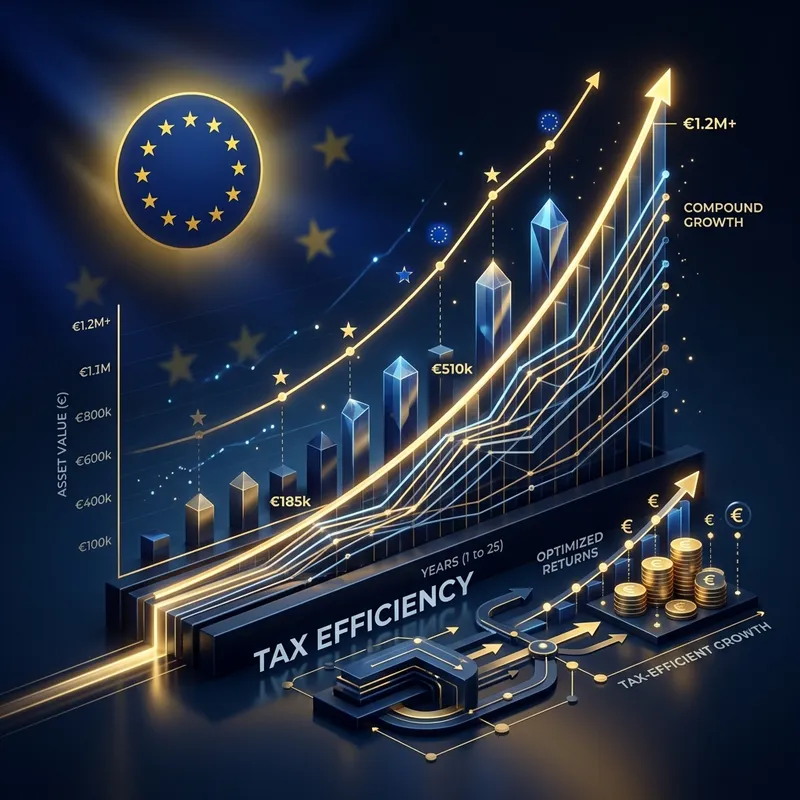
Investing in quantitative and tactical strategies like Global Equity Momentum (GEM) or All Weather Portfolio from Europe can be a major challenge due to the complex tax landscape and regulatory restrictions. This guide breaks down the rules of tax-efficient investing in the EU, explaining UCITS compliance, fund domiciles, accumulating structures, and tax-deferred momentum execution.
1. The PRIIPs Regulation and the UCITS Shield
Since 2018, European retail investors have faced a massive hurdle when attempting to invest in US-domiciled Exchange-Traded Funds (ETFs) such as the popular Vanguard S&P 500 ETF (VOO) or SPDR Gold Shares (GLD). Under the European Union's Packaged Retail and Insurance-based Investment Products (PRIIPs) regulation, brokers are prohibited from offering investment funds to retail investors unless the fund manager provides a Key Information Document (KID).
Because major US fund providers (like Vanguard, BlackRock, or State Street) have no legal obligation to produce KIDs for their US-registered products, retail brokers across the EU block purchases of these funds.
The solution for European investors is to use UCITS ETFs. UCITS (Undertakings for Collective Investment in Transferable Securities) compliant funds are registered in Europe, provide the necessary KIDs, and are fully accessible to retail investors. While they track the exact same benchmarks as their US counterparts, their tax structures and tickers differ significantly.
2. Domicile Matters: Why Ireland Wins
When selecting a UCITS ETF, the country where the fund is legally domiciled plays a crucial role in your long-term returns. The two most common domiciles for European ETFs are Ireland and Luxembourg.
For investments in U.S. equities, Ireland is the clear winner. Under the double taxation treaty between the United States and Ireland, Irish-domiciled ETFs benefit from a reduced withholding tax rate of 15% on dividends paid by US companies, compared to the standard 30% rate. Luxembourg-domiciled funds do not benefit from this treaty rate for ETFs, meaning they incur a 30% drag on all US stock dividends before the fund reinvests or distributes them. Over a 20-year investing horizon, this 15% difference in internal dividend taxation adds up to thousands of Euros in lost compounding efficiency.
3. Accumulating vs. Distributing ETFs
UCITS ETFs come in two distribution configurations:
- Distributing (Dist / Dis): The fund pays out cash dividends directly to your brokerage account, usually on a quarterly or semi-annual basis.
- Accumulating (Acc): The fund automatically reinvests all dividends back into the fund's assets, increasing the Net Asset Value (NAV) per share without distributing cash to investors.
For investors in most European countries (such as Poland, Germany, Spain, and France), Accumulating ETFs are highly tax-efficient. When a distributing ETF pays out a dividend, it triggers an immediate capital gains or dividend tax liability in your local country, requiring you to report and pay taxes annually.
Accumulating ETFs defer this tax liability. Because the dividends are reinvested internally by the fund, no cash enters your brokerage account, and in most jurisdictions, no tax is owed until you sell the ETF shares. This deferral allows 100% of the dividend payout to remain invested, magnifying the compound interest effect over time.
4. Managing Momentum Rebalancing Taxes
Tactical strategies like GEM (Global Equity Momentum) and Dual Momentum (DM) require rotating assets (e.g., selling S&P 500 and buying bonds) when momentum signals change. In a standard brokerage account, every asset rotation is considered a taxable event, triggering capital gains taxes (e.g., 19% "Belka tax" in Poland, 25% Abgeltungsteuer in Germany, or 20% Capital Gains Tax in the UK).
Frequent taxable rotations can severely erode the performance advantage of tactical strategies. To protect your returns, you must run these strategies within **tax-advantaged wrappers** or **tax-deferred accounts** available in your country:
- Poland: Use **IKE** (Indywidualne Konto Emerytalne) or **IKZE** (Indywidualne Konto Zabezpieczenia Emerytalnego). Capital gains and transactions within these wrappers are entirely tax-free, allowing monthly rebalancing without tax drag, provided you do not withdraw funds until retirement.
- United Kingdom: Use a **Stocks & Shares ISA** (Individual Savings Account). Up to £20,000 can be contributed annually, and all transactions, capital gains, and dividends within the ISA are permanently tax-exempt.
- Germany: While Germany does not have a tax-free ISA equivalent, investors can utilize the **Sparer-Pauschbetrag** (tax-free allowance of €1,000 per year per person) or execute strategies via tax-sheltered private pension wrappers (Rürup or Riester-Rente) that support UCITS ETFs.
5. US ETFs to UCITS Equivalents Cheat Sheet
To implement StrategyIndex.io models in Europe, use this mapping sheet of popular US ETFs to their high-liquidity, Irish-domiciled, accumulating UCITS equivalents:
| US Asset Class | US ETF Ticker | UCITS Equivalent | UCITS Ticker (Acc) |
|---|---|---|---|
| US Large-Cap Stocks | VOO / SPY | iShares Core S&P 500 UCITS ETF | SXR8 (EUR) / VUAG (GBP) |
| Global ex-US Stocks | VXUS / ACWX | Vanguard FTSE All-World UCITS ETF | VWCE (EUR) / VWRA (USD) |
| Aggregate Bonds | BND / AGG | iShares Core Global Aggregate Bond | AGGH (EUR hedged) / EUNA |
| Physical Gold | GLD / IAU | iShares Physical Gold ETC | SGLN (GBP) / EGLN (EUR) |
| Long-Term Treasuries | TLT | iShares $ Treasuries 20+yr UCITS ETF | DTLA (USD) / IBGL (EUR hedged) |
6. Conclusion: The European Quant Checklist
To maximize your investment returns and minimize taxes while following StrategyIndex.io models in Europe:
- Open a brokerage account that supports Irish-domiciled UCITS ETFs and, if possible, place it inside a local tax-sheltered retirement account (e.g., IKE/IKZE or ISA) to eliminate rebalancing tax drag.
- Choose Accumulating (Acc) versions of ETFs to defer local capital gains and dividend taxes.
- Ensure you are purchasing Irish-domiciled ETFs (marked by an ISIN prefix starting with IE, e.g., IE00B4L5Y983) to claim the US-Irish dividend treaty benefit.
- For bond and cash components, decide if you require currency hedging (EUR/GBP hedged) to shield against US Dollar volatility, or if you prefer unhedged exposure.
Ready to apply this strategy?
Take the next step by exploring our free interactive tools, live allocations, and calculators.
Deep Dive: EU Investing & UCITS ETFs
Explore our comprehensive cluster of articles, guides, and tools dedicated to European investors.